
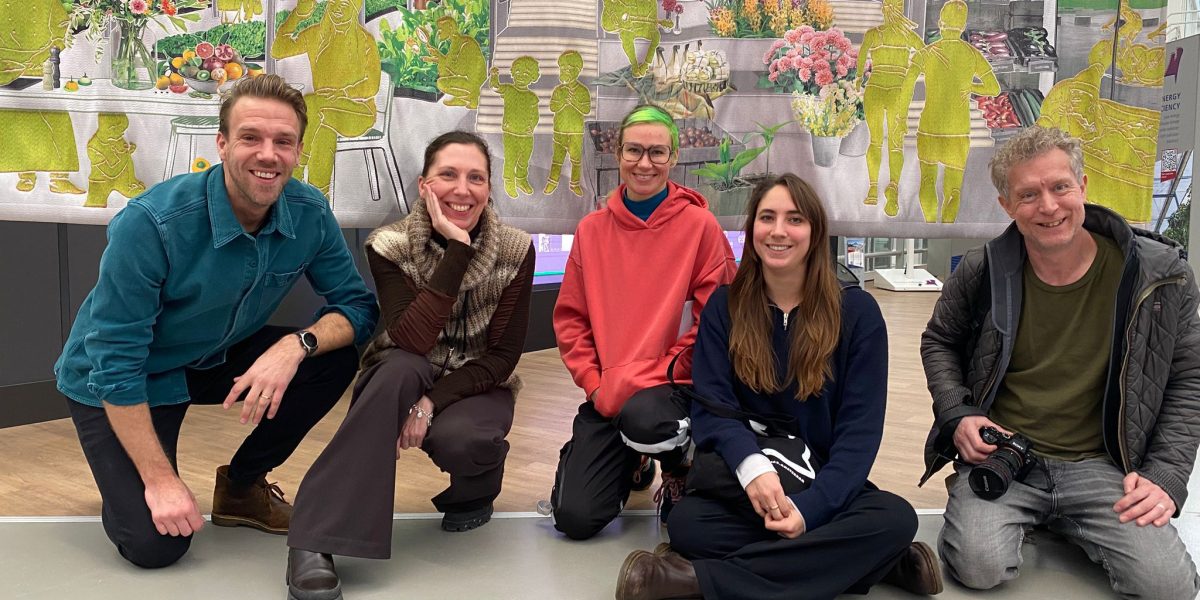
Artists in residency
The EatThis In-Residency program kicked off with an inspiring and immersive journey into the world of modern horticulture, bringing together artists in residence and the complex systems behind how our food is grown. Across the first three days, participants explored high-tech greenhouses, research facilities, seed innovation, and biological crop protection—encountering new perspectives on food production, care, and responsibility.
Day 1 offered a powerful introduction. Visits to the Westland Museum and several high-tech vegetable growers, including tomato and mini cucumber producers, revealed both the historical roots and the cutting-edge present of horticulture. The day concluded with insights into the use of AI and computer vision in food production.
For many, stepping into a greenhouse for the first time was transformative. One artist described it as a completely new sensory experience—an unfamiliar way of seeing how food comes into being. Another reflected on the contrast between her work in allergy research, which often deals with uncertainty and error, and the highly controlled, almost error-free environments designed to care for plants. This shift sparked a new way of thinking about food, control, and care.


Day 2 deepened the exploration by placing horticulture within a broader ecosystem of innovation. The artists visited Koppert Cress, Division Q, Rijk Zwaan, and Priva, encountering seed banks, automated growing systems, and sustainable technologies shaping the future of food. A particularly striking moment was being among the very first visitors to Rijk Zwaan’s new seed packing facility—standing before a vast seed storage space where global food futures are quite literally stored.
This immersion raised new ethical and philosophical questions. As one participant reflected, the artificial landscapes of greenhouses—designed entirely by humans—challenge us to reconsider how living organisms exist within these systems, and what responsibilities come with such control over life.
Day 3 focused on research, education, and biological solutions. At the World Horti Center, the artists engaged with the global horticultural network, followed by in-depth discussions at Vertify’s research facilities on monocultures, innovation, automation, and technological dependence. The day concluded at Koppert, where biological crop protection and biostimulants opened an entirely new world—introducing insects, fungi, and microorganisms as key actors in sustainable food systems.
The conversations here became more speculative and critical. One artist wondered what might happen if the efficient, controlled, and automated world of horticulture were to intersect with regenerative agriculture. With a background in allergy research, she reflected on the value of diversity and contamination as forms of preventive care, questioning how systems built on monoculture and protection might coexist with more diverse, regenerative approaches. Another artist noted that while biological solutions offer hopeful alternatives to pesticides, they also raise important ethical questions about the mass production and global distribution of living organisms.

As the residency moves toward its final day, these reflections continue to resonate. The first three days have offered not only insight into advanced food systems, but also space to question how technology, biology, and sustainability can—and should—interact. With curiosity heightened and perspectives shifted, the artists now head into the final stage of the In-Residency, carrying forward questions that extend far beyond the greenhouse walls 🌍🌱.